Albany’s $268 Billion Budget Hangs Fire, Lawmakers Shrug Off Hochul’s Premature Deal Cheers
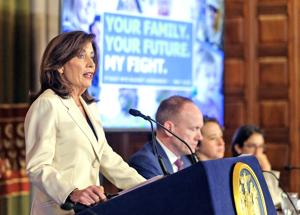
New York’s prolonged state budget deadlock reveals deeper strains over how, for whom, and by whom the city’s fortunes are decided.
Spring weather has returned to New York, but a familiar wintry chill lingers in Albany. Six weeks after the April 1st deadline, legislators are still negotiating the contours of what is now postured as a $268 billion behemoth, the state’s largest-ever spending plan. For the 11th time, lawmakers passed a stopgap “extender” to keep the government’s lights on. The only thing less predictable than upstate weather, it seems, is when New York’s budget will finally materialise.
On May 7th, Governor Kathy Hochul trumpeted what she called a “general agreement” for fiscal year 2027. Key budget figures, however, demurred—Assembly Speaker Carl Heastie flatly labelled her declaration “premature.” By Tuesday, most points of contention remained unbrokered; not a single budget bill nor an updated financial plan had crossed the finish line. “There are still major issues that have yet to get worked out,” admitted State Senator Joe Addabbo Jr., pointing to unresolved disputes over church protest “buffer zones,” car insurance reforms and new environmental strictures.
Assemblyman Andrew Hevesi put it more bluntly. “The frustration is starting to build up… this is not budgeting,” he complained, describing the protracted process as “the governor’s personal session.” His point is not novel. In New York, the peculiar architecture of budget power, an artifact of reforms dating to the 2000s, grants the executive branch a heavy hand in both fiscal and policy agendas; the legislature’s complaints of marginalisation surface every year, as regularly as cherry blossoms in Central Park.
For Gotham, this recurring budget kabuki is hardly abstract. Roughly a third of New York City’s revenues depend on state largesse—from schools to mass transit to Medicaid. Any delay or ambiguity in Albany’s budgetary resolve ricochets down through the five boroughs’ agencies and contractors, who must make do with educated guesses and contingency planning. Schools fret about per-pupil funding; homeless shelters await word on rental subsidies; and city leaders eye subway subsidies and anti-crime outlays with growing unease.
Yet the real sticking points this year lie not just in comma counts, but in the state’s ambitions to regulate life in one of the world’s largest urban economies. The proposed budget tacks on New York’s first-ever pied-à-terre tax, aimed at the absentee rich whose multi-million-dollar second homes allegedly bloat real estate prices, but rarely light up at night. For luxury properties in the city valued above $5 million, the tax would add a yearly surcharge—potentially yielding hundreds of millions in new city revenues. Council progressives such as Mayor Mamdani have already lauded the policy with commendable performative zeal, but critics query whether such a measure will do much more than deterring foreign buyers and nudging luxury developers toward Miami.
Also knotted up in negotiations are proposals to create new buffer zones around houses of worship, tightening regulation on protesters, as well as insurance reforms in a market battered by rising rates and increasingly frequent claims. Environmental advocates eye stronger climate and energy standards, while the business lobby warns against over-regulation. Seen together, these squabbles reflect the larger question haunting the city and state: can policy “nudge” the market into better behaviour, or will each new lever simply drive capital and talent elsewhere?
Budget impasses, of course, are not unique to New York. Statehouses from Sacramento to Springfield are often bedeviled by the push-pull between executive ambition and legislative inertia. But New York’s budgetary theater is singular for its size, pageantry and the sheer number of fiscal knots it attempts to untangle at once. Only California spends more, per capita, among US states. And while Albany’s pretensions toward social engineering are perennial, so too is the gnawing anxiety that each round of tax hikes or regulatory tightening eats away at the city’s global economic magnetism.
Who gets to set the terms
Albany’s deadlock is instructive for another reason: it betrays a consensus, among both left and right, that the city’s economic base is both indispensible and imperilled. Democrats call for redistributive taxes and protections for working families; Republicans chide those policies as self-defeating. Yet both camps tacitly accept the fragility of New York’s status—its status as a hub of finance, tech and culture depends, they know, on not driving away the very “rich” whose resources they propose to squeeze.
Meanwhile, the city’s working and middle classes find themselves caught in the crossfire. The late budget has already paused payments to state legislators—a populist gesture, perhaps, but small comfort to the public employees, contractors and landlords below them. Policy uncertainty also bodes ill for business investment, particularly in an era when telework means the best and brightest can decamp to Miami or Austin with a laptop and a MetroCard refund.
Internationally, New York’s predicaments are mirrored in London, Paris, and Toronto, where debates over taxing wealth, nudging behaviour and keeping cities affordable have come to the fore. The global competition for talent is palpable; cities that mishandle their budgets risk hollowing out their tax bases, even as they pile new expectations on the remaining few.
Governing by deadline and extender is, sadly, a tradition in America’s largest states. But New York’s extended kabuki hints at something more corrosive: a budgetary process unable to separate substance from theatre, and policy from posturing. Trust in Albany patently hangs by a thread, as even lawmakers from the ruling party deride executive overreach and legislative impotence with public frankness.
Despite the procedural shambles and the posturing on both sides, the stakes remain. The raft of proposed changes—especially the pied-à-terre tax—makes the city a useful laboratory for the politics of taxing wealth, redistributing gains, and regulating urban life. Whether these experiments produce sustainable results, or merely foster further flight among the affluent, is a test not just for New York but for every global city pondering its own post-pandemic future.
For now, New Yorkers must endure periodic bluster and mounting uncertainty as their elected officials haggle over dollars and words. The city is accustomed to improvising under pressure; its residents excel at adapting to both meteorological and political weather. Yet even the most weathered Gothamite may tire of waiting for a budgetary spring that never seems to quite arrive. ■
Based on reporting from www.qchron.com - RSS Results of type article; additional analysis and context by Borough Brief.