City Council Presses Mamdani for Automatic Fair Fares Enrollment as Free Bus Plan Stalls
New York’s debate over free buses and automatic transit discounts will test how, and for whom, the city invests in mobility and urban equity.
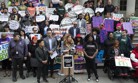
On a sodden Wednesday morning at City Hall, the call for free buses echoed with renewed vigour from an unlikely quarter: the City Council itself. Speaker Julie Menin, flanked by a cohort of council members, braved the drizzle to demand not only a sweeping expansion of the Fair Fares program, but to jab at Mayor Zohan Mamdani’s transit priorities. The city, Menin reckoned, could—and should—do more to drag hundreds of thousands of low-income New Yorkers onto public transport at little or no cost.
At the heart of the dispute lies Fair Fares, a municipal initiative launched in 2019 that provides half-priced subway, bus, and paratransit fares for adults aged 18 to 64 earning less than 150% of the federal poverty threshold. Of the estimated 1.3 million Gothamites eligible for these reduced fares, a paltry 380,000—or just 35%—are currently enrolled. The Council’s latest gambit would automate this sign-up, and, in an even bolder stroke, make all fares entirely free for those who qualify.
The math is not trivial. By the Council’s own estimates, full fare coverage for all eligible residents would cost an additional $130m per annum, on top of the program’s already non-negligible $86m annual price tag. Enrollment, if auto-triggered, could swell by nearly a million, according to city projections. In an era where New York faces a multibillion-dollar budget deficit—an oft-invoked spectre by Mayor Mamdani—every dime is subject to public scrutiny (and, it must be said, political gamesmanship).
Such dollars are not merely figures in a ledger; they speak to the city’s priorities. Public transportation is as much a social contract as a public utility in New York. The City Council’s view is clear: at a time when inflation gnaws at paychecks and housing costs balloon, transportation should not be a further means of exclusion. By pressing for automatic enrollment and total fare coverage, the Council signals both exasperation with bureaucratic inertia and a larger ambition to weave a sturdier social safety net.
Critics, though, have not been bashful. The Citizens Budget Commission, the city’s emblem of fiscal conservatism, released a report ahead of the hearing that favours expanding Fair Fares—up to 250% of the poverty line—but stopping well short of making rides gratis. A 50% discount, they argue, helps maintain necessary farebox revenue and disciplines public spending, while still providing a meaningful hand up. The city’s Human Resources Administration, which manages Fair Fares, has acknowledged the low take-up rate, blaming privacy constraints and patchy data-sharing across agencies.
For his part, Mayor Mamdani floats yet another balloon: fare-free buses for all, regardless of income. It is a popular idea in the abstract, but so far it sits untethered from both legal authority (the Metropolitan Transportation Authority, or MTA, ultimately sets fares) and fiscal reality (nobody knows the true cost, but estimates range well into the hundreds of millions). MTA officials, as well as the CBC, reckon the city’s finite resources are better spent on targeted relief rather than universal largesse, at least for now.
At stake is not just the logistics of subsidy, but the very architecture of urban mobility. Public transit is the circulatory system of New York; when whole segments of the population struggle to afford a ride, the city’s social and economic metabolism is hobbled. Under-enrollment in a program explicitly designed to help working-age poor New Yorkers suggests that paperwork and outreach—not just budget gaps—are to blame. Automatic enrollment promises to remedy bureaucratic torpor, though it could also fatten enrollments and, with them, the bill.
A global city on the cheap?
Zooming out, New York’s wrangle mirrors challenges faced by transport networks in other sprawling metropolises, from London to Seoul. Paris offered fare-free temporary measures during transport strikes; Vienna boasts heavily subsidized annual metro passes, helping to drive car use down. Yet, almost universally, cities must weigh ambitions for social equity against the iron discipline of the balance sheet. Current farebox revenue remains the financial lifeblood for transit operations—a source hard to replace in full without recourse to higher taxes or new state subsidies.
The persistent tug-of-war between targeted aid and universal programs is no mere academic squabble. Universality brings simplicity and reduces stigma, but guaranteed benefits for all risk spreading resources thin. Targeted subsidies, like Fair Fares, are more cost-efficient—but only if those most in need actually receive them. New York’s abysmal take-up rate reveals a system that is, in practice, stingier than it appears on paper.
All the while, the city’s transport network—famously described as both “gargantuan” and “creaky”—faces a host of pressures: surging ridership post-pandemic, creased infrastructure plans, and a notoriously fractious relationship between City Hall and the MTA. Mayor Mamdani’s unwillingness to commit either to Council’s proposal or his own “free buses for all” campaign suggests an administration stymied by fiscal arithmetic and institutional constraints.
As the debate simmers, some ironies bubble up: New York, seat of American urban dynamism, is making global headlines not for extravagant investment, but for quibbling over which flavour of subsidy to expand. The sums in question—while hardly paltry—represent a sliver of the city’s $107bn budget. And the broader stakes are less about copper coins than about the credibility of a city that touts mobility and inclusivity as cardinal virtues.
Reason, we think, must prevail over grandstanding. City leaders would do well to focus on shoring up the existing Fair Fares program: push for automatic enrollment, extend eligibility up the income scale, and make the process as frictionless as possible. Making the program entirely free may be a bridge too far, at least for now. But there is a world of practical improvement before that threshold.
Ultimately, the test for New York will not be whether it can magic up a fleet of free buses, but whether it can fashion public policy that is both humane and hard-headed. In the long run, a well-run, inclusive transit system pays for itself—if only the city’s leaders can muster the discipline and the administrative energy to deliver it. ■
Based on reporting from City & State New York - All Content; additional analysis and context by Borough Brief.