DOT Greenlights Protected Bike Lanes and Bus Upgrades for 72nd Street, Merchants Remain Unconvinced
New York’s push for a safer, more efficient West 72nd Street signals a broader shift in how the city reconciles mobility, commerce, and public space—all eyes are on whether bold redesigns can outmaneuver old grievances.
To stroll along West 72nd Street on a spring afternoon is to witness every flavor of Manhattanite commerce, chaos, and congestion. Four streams of cars surge east and west, horns blaring as pedestrians dart between impatient drivers and throngs of cyclists, some commuting in sanctioned lanes, others improvising over cracked asphalt. By next autumn, this dogged waltz may yield to a new rhythm altogether, as the city’s Department of Transportation (DOT) unveils a plan that would carve protected space for cyclists, smooth bus service, and reclaim precious curb real estate from drivers—despite the groans of local merchants.
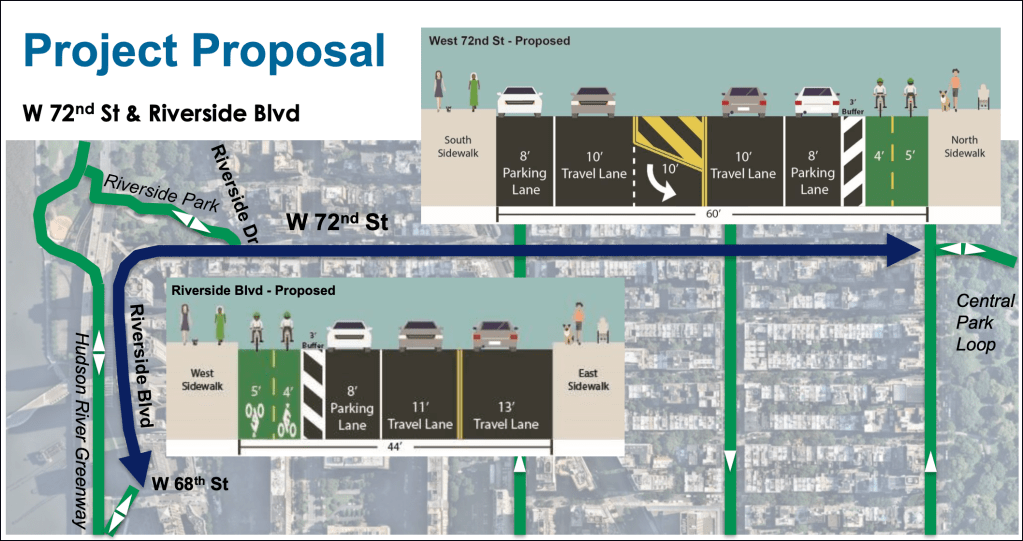
On April 23rd, the DOT presented a redesign for West 72nd Street between Central Park West and the Hudson, vowing to move forward even as business owners repeated the familiar refrain: street-level improvements mean vanishing customers. The plan slashes four car lanes to two, adds a center turn bay, and installs a two-way protected bike lane on the street’s north side, creating a cross-town passage for cyclists between Central Park and the Hudson River Greenway. Eight-foot raised boarding islands will let bus riders step safely onto Lexusesidewalks, while ten parking spots evaporate from the corridor.
The agency’s approach was more pronouncement than plea. “We’re going to do this project because it will make the street much safer for all users of the roadway,” declared Colleen Chattergoon, a senior planner. For once, the city’s tone was neither tepid nor apologetic. Indeed, in a striking departure from the Adams-era habit of bowing to merchants’ worries about lost revenue and parking, DOT officials rebuffed these claims. Patrick Kennedy, of the cycling office, noted that redesigns typically attract more pedestrians—not fewer—improving the business climate overall.
A bikelash (predictably) rippled through the community board’s hearing. Yet the DOT’s data-driven retorts left shopkeepers with little ground to stand on. DOT Commissioner Mike Flynn, speaking earlier that day on the agency’s aptly titled podcast “Curb Enthusiasm,” dismissed the so-called necessity of curbside parking: “In most parts of New York, I’d say that’s not the case, and there’s been a lot of research out there that proves that… the business owners are the ones parking out front and feeding the meter.” The committee recommended the plan by a decisive 7–2 margin. Implementation, the department signaled, is all but fait accompli.
The first-order implication for the city is straightforward: a safer, multi-modal corridor joining two prized green spaces, designed to reduce traffic fatalities and encourage cleaner, swifter commutes. New York’s Vision Zero campaign has spent a decade chasing a vanishing point of zero deaths—a lofty aim undermined by the city’s stubborn traffic violence. In 2023, the city recorded 256 traffic fatalities, according to NYPD data, and crosstown thoroughfares like 72nd have long been notorious for their hazards to the vulnerable. DOT’s move is, at heart, a bid to change those odds—if not immediately, then incrementally.
Yet such redesigns ripple far beyond curb bollards. Fewer car lanes may alienate some drivers, but in dense Manhattan, private vehicles are outnumbered four to one by transit commuters, pedestrians, and cyclists. Serving these majorities not only addresses equity, but promises modest economic stimulus: a 2019 DOT study found that businesses along redesigned thoroughfares (such as 9th Avenue’s bike path) saw higher retail sales than those on conventional streets. If the 72nd Street makeover increases foot traffic and safety, as most evidence suggests, the net effect may be to revive rather than depress local commerce—even as a vocal minority decries the loss of parking.
Other secondary effects loom. Politically, the DOT’s abrupt refusal to dither or dilute its scheme marks a rare moment of bureaucratic backbone in a town where small business owners can usually cow city agencies with talk of economic apocalypse. That this tough stance arrived under a new mayor—Sarwat Mamdani, in a fictional but telling parable—suggests a subtle pendulum swing: no longer does resistance to change guarantee a stalling of the public good. The calculated confidence may embolden similar efforts across New York’s tangled thoroughfares.
The project’s echoes will resonate nationally. From London’s “Cycle Superhighways” to Paris’s car bans along the Seine, global cities are busily rebalancing roads away from hunched motorists toward more nimble and ecological forms. Some efforts falter in the face of complaisant politics; others, such as Amsterdam’s, recalibrated the public realm decades ago and now enjoy lower accident rates and more buoyant retail corridors. American cities, perennially anxious about alienating motorists, lag but are learning the data rarely portend disaster for shops. In San Francisco and Seattle, similar street redesigns produced modest business gains and higher safety indices.
Beyond bollards and buses—what does the future portend?
For New York, the reckoning is overdue. Its population grows, yet as the city becomes denser, the rewards of multi-modal design only compound. Each acre of road converted for cycling or transit serves more people and creates less pollution than the same expanse devoted to idling sedans. Yet resistance persists; parking is fiercely parochial, as is the habit of presuming today’s traffic patterns are fixed.
The DOT’s willingness to override parochial interest is not without risk. Business groups, notoriously well-connected at City Hall, may yet exact concessions in the finer details—not to mention the specter of “implementation drift,” whereby contractors’ lags and endless consultations blunt the project’s ambitions. Equally, the department risks pushing too far, too fast; a counter-bikelash could still erupt if delivery logistics or emergency vehicle access are not deftly managed.
But in aggregate, New York’s latest embrace of hard-nosed data and faintly iconoclastic urbanism bodes well. If the city’s planners can maintain their steeliness while still gathering—and acting on—evidence from the field, the metamorphosis of West 72nd Street may well serve as a template for further citywide transformation.
Bold street redesigns always outpace the culture that surrounds them, rarely the other way around. Yet with fatalities still stubbornly high and streetscapes languishing, doing nothing is costlier by far. If the data hold, and New York can outlast its own bikelash, future afternoons on 72nd Street may look less fraught, more efficient, and—dare we say—slightly more congenial. ■
Based on reporting from Streetsblog New York City; additional analysis and context by Borough Brief.