Leasing Opens at LIC’s 823-Foot Orchard, Boasting 248 Lottery Homes and a Giant Backyard
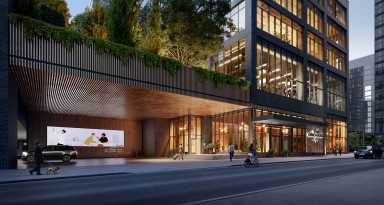
The debut of Long Island City’s new tallest tower, The Orchard, highlights the challenges and ambitions of New York’s vertical housing future.
Barely a generation ago, the stretch of Queens skyline across from Manhattan’s Midtown teemed with freight yards and auto-body shops. Now, steel and glass monoliths crowd the horizon. The latest and loftiest of the lot, The Orchard, has just opened its 70 stories for leasing, at 823 feet the tallest residential building in Long Island City (LIC). This is no mere feat of engineering: it is another milestone in an urban metamorphosis that continues to reshape New York’s real estate—and expectations for how, and where, its people will live.
BLDG Management, the developer, began leasing of the Orchard’s 824 apartments on January 12th, and applications for 248 “affordable” units will be accepted by lottery through January 28th. The remainder—576 market-rate flats—will test whether luxury living outside the usual Manhattan haunts remains buoyant amid New Yorkers’ shifting appetites and fiscal uncertainties. Lloyd Goldman, BLDG’s president, calls the project an homage both to neighbourhood heritage and modern aspirations, a vision writ large in brick and glass by architects Perkins Eastman.
The specifics are suitably grand. Residences, stretching from studios to three-bedroom apartments, tout floor-to-ceiling windows, modern fixtures, in-unit laundry, and either private or semi-private balconies. Amenities—once an afterthought, now the developer’s not-so-secret weapon—run to excess: 100,000 square feet for pools, a 60,000-square-foot planted “backyard,” pickleball courts, a running track, an outdoor movie screen, and splashes of orchard greenery curated by landscape architect Hank White.
The launch matters for more than its skyline punctuation. The Orchard is a bellwether for both New York’s rental market and its perennial infatuation with reinvention. Its 248 subsidised units reflect the de Blasio-era “mandatory inclusionary housing” policies, which require big developments in rezoned areas to offer affordable homes. Yet these periodic lotteries, competitive as Ivy League admissions, cannot alone stem the city’s affordability crisis. According to the NYC Department of Housing Preservation and Development, the city’s rent burden remains stubbornly high: over 53% of renters spend more than 30% of their income on rent.
Such developments offer the promise of density—but not necessarily social diversity. Critics note that luxury towers, peppered with token affordable units, often reinforce rather than erode the walls between haves and have-nots. Mixed-income policies, though mathematically generous, can look puny beside demand: last year’s affordable-housing lottery for a similar-sized Queens building drew over 70,000 applicants for 200 subsidised homes.
Still, the Orchard’s arrival does bring economic stimulus, both direct and diffuse. The tower’s retail spaces bode well for jobs and neighborhood vitality. Local restaurants and shops stand to gain fresh foot traffic; the area’s property-tax base will fatten. Yet LIC’s transformation, spurred by 2001’s rezoning, has already ignited fierce debates about gentrification, displacement, and infrastructural strain. This surge of high-end supply risks stoking demand on the city’s overtaxed subways, schools, and utilities as thousands of new residents jostle for finite local resources.
The bet on “amenitized” vertical living is both psychological and economic. Developers hope that the promise of cabana-strewn lawns and Instagrammable chess sets can lure not just young professionals priced out of Manhattan, but families searching for safety and schools. During the pandemic, urban flight briefly wounded the appeal of high-rise communities. Now, as rental prices rebound (the median Queens rent reached $3,400 in December 2023, according to Douglas Elliman), the pressure is again on towers like the Orchard to justify their hefty price-tags and reassert the virtues of density.
New York’s experience is not unique. Across global capitals—London, Toronto, Singapore—high-rise megaprojects purport to reconcile density with comfort and sustainability. Yet the record is mixed: vertical communities require more than swish amenities to mesh residents with neighborhood fabric. Without careful planning and investment in transport, public space, and safety, towers risk becoming islands in the city—gargantuan, yes, but unmoored.
Uphill climb for vertical utopias
The bigger question is whether buildings like the Orchard genuinely help solve the country’s urban housing conundrum. America faces a puny pipeline of affordable homes relative to need. New York’s incremental approach—mandating a smattering of affordable units in luxury towers—may look bold to municipal policymakers, but it is tepid by global standards. Vienna, for example, manages to supply hefty shares of social housing city-wide, not just as a garnish to private development.
It is unclear, too, who will thrive in buildings such as this. Young urbanites in creative industries may find its blend of amenities and access irresistible. But families and essential workers, priced out even of “affordable” rents, may see little gain. Meanwhile, LIC’s once-thriving small businesses, long under siege by rising commercial rents, reckon with another wave of upward pressure.
For planners, the challenge is not to sneer at ambition, but to channel it. More rental inventory in a city of chronic shortage is plainly necessary. Yet large-scale towers must knit into the urban landscape, not simply overshadow it—forbidding rents upstairs and fading shopfronts below are the twin risks of unchecked vertical growth.
There is cause for guarded optimism. New York’s resilience, honed through decades of economic shocks and population ebbs, remains potent. If towers like the Orchard can spur citywide conversations about what truly constitutes affordability, and if policymakers draw inspiration from more audacious global models, there is hope for a housing policy less timid and piecemeal.
But the city cannot rely on the private sector’s largesse alone. The housing crisis is too severe, and the disparities too glaring. Piecemeal inclusionary mandates are no substitute for bold investment in transit, schools, and large-scale, truly affordable construction. A city that aspires to house millions must face up to the scale of its own ambition.
If the Orchard flourishes, its significance will lie not in its winking glass or picket-fenced amenities, but in whether it helps rebalance New York’s gravitational pull—a reminder that the quest for vertical utopias, though daunting, need not be quixotic.■
Based on reporting from QNS; additional analysis and context by Borough Brief.