Mamdani Seeks $21 Billion in Federal Funds for 12,000-Unit Sunnyside Yards Plan
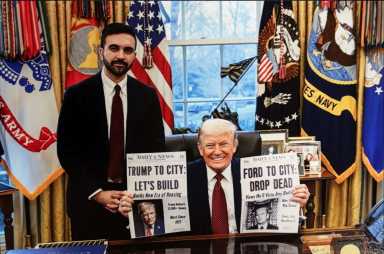
With New York’s housing crisis deepening, a rare display of bipartisan overture may mark the city’s biggest federal ask for public housing in half a century.
The city that once had to beg Washington not to “drop dead” is now courting the White House to bankroll one of America’s most ambitious urban housing projects. On June 13th, in a move both theatrical and substantive, Mayor Zohran Mamdani met with President Donald Trump to press for $21 billion in federal funding for a scheme to build 12,000 affordable homes atop Sunnyside Yards in Queens. Mr Trump’s fondness for photo-ops is hardly news, yet grinning for the cameras while holding up two Daily News front pages—a 1975 relic bemoaning federal neglect, paired with a present-day mock-up lauding presidential largesse—signalled that something different may be afoot.
At stake is not just a high-profile ribbon-cutting, but a test for whether New York can overcome years of inertia to address its swelling housing shortage. The proposed development, moribund since 2020, envisions decking over more than a hundred acres of active rail yard—a feat of civil engineering and political coalition-building. “Let’s build,” urged the mayor, echoing Trump’s own campaign slogan and, perhaps, appealing to the president’s well-known appetite for concrete achievements.
The plan’s bones are byzantine but familiar. The Sunnyside Yard Master Plan, drafted with Amtrak (which owns most of the land), calls for 12,000 affordable units, 60 acres of parks and open space, and the promise of equity—via homeownership schemes and community amenities for long-neglected Western Queens. The city’s Economic Development Corporation reckons that just building the deck would swallow at least $5.4 billion, with full site infrastructure sending the tab well north of $14 billion.
New York badly needs housing, and not just of the luxury, skyline-altering sort. Vacancy rates for rental units are a measly 1.4%, their lowest in decades, while shelter populations recently hit record highs. The mayor’s office aims for at least 6,000 of the new homes to use the once-robust but long-underfunded Mitchell-Lama model—an echo of mid-20th-century experiments in mixed-income, cooperatively owned housing. Whether the vision can survive the famously fractious city planning process, the litigious opposition of neighbourhood groups, or the fickle hand of federal appropriators is another matter entirely.
If Washington cuts the cheque, the implications for New York could be prodigious. For one, city officials would prove that city–federal cooperation remains possible, at least when mutual self-interest overrules tribal politics. The capital would allow the city to convert a stranded asset—an expanse of rails dividing Long Island City from Sunnyside—into a new quarter of affordable homes and public space. For Mr Trump, a native New Yorker rarely embraced by the city’s political class, it offers a measure of redemption: the chance to mend the wounds inflicted by the legendary “drop dead” headline, this time clad in concrete and steel.
Beyond bricks and mortar, the economic knock-ons would be substantial. The city estimates decades of construction jobs, the creation of thousands of affordable units, and a surge in ancillary business for Western Queens. A federal housing infusion of this size—recalling only the urban renewal era or the postwar birth of Stuyvesant Town—would bolster the city’s fraught construction pipeline and perhaps nudge its stagnant housing politics towards pragmatism. Whether that would portend a wider embrace of state-led development, or fuel further wrangling over zoning, subsidies, and market interventions, is an open question.
Political risks abound. Neither party is immune: progressives are apt to bristle at cooperating with a president many view as anathema; conservatives may carp at the scale of federal outlays or the wisdom of mass public housing. Mr Mamdani’s gambit, pitching directly to the Oval Office, highlights both the opportunity and the hazards of bypassing Albany and usual city council fudge-making. Support from Amtrak is necessary but not guaranteed. The fraught federal appropriations process, currently subject to partisan brinkmanship, could derail the project at any stop.
National comparisons and the battle for affordable housing
New York’s request stands out even amid a national housing crisis. Other metropolises—San Francisco, Boston, Seattle—are desperate for public investment, but few have mounted so grand a proposal on so expensive a patch of urban land. Globally, cities from Singapore to Vienna have shown that, with sustained political will and federal backstops, mass affordable housing is possible. The big bet in Queens will test whether America can still match such examples, or whether gridlock, inflation, and NIMBYism now form insuperable barriers.
For New Yorkers, the proposal is a rare alignment of scale and necessity. The city’s annual housing production has lagged demand for years, while state and federal cash have, until recently, been tight. Though 12,000 homes will not tip the supply-demand scales on their own, the project’s success would set a valuable precedent for tapping federal coffers—and for showing that public housing need not be a byword for dysfunction.
We remain sceptically optimistic. New York’s Lorelei call for robust, affordable urbanism has shipwrecked many a grand plan. But the mayor’s cheeky invocation of presidential ego—pairing a notorious snub with an invitation—reveals a promising shift from litany to action. If Mr Trump yearns for a legacy beyond lawsuits and cable news cameos, delivering on “Let’s Build” might finally put Ford’s ghost to rest, and give New York’s renters something sturdier than tabloid headlines to hang their hopes on. ■
Based on reporting from amNewYork; additional analysis and context by Borough Brief.