Senate Backs New York Election Worker Protections, AI Crackdown, and Super Tuesday Play
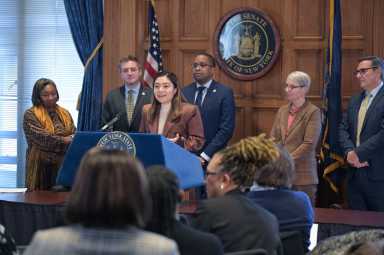
New legislation in Albany offers a shield for New York’s elections, but the devil, as ever, lies in the details and execution.
The machinery of democracy seldom seizes the public imagination, but when the gears grind or gum up, the spectacle is hard to ignore. The New York State Senate, in its annual “Democracy Day” legislative burst on June 6th, voted through a suite of election reforms that, if their backers are correct, could make voting safer, fairer and—critics contend—just a little more complicated.
At the centre of the package are bills authored by a phalanx of New York City senators: Kristen Gonzalez and Michael Gianaris, both of Queens, alongside Senate Majority Leader Andrea Stewart-Cousins and Brooklyn’s Zellnor Myrie. Their targets: foreign-backed corporate money, digitally fueled disenfranchisement, abusive behaviour toward election workers and muddled residency rules that trip up city dwellers with country homes.
Senator Gonzalez’s S.8646A addresses what a growing number of states have flagged as a crisis: intimidation of the officials who staff polling places. Since 2020, harassment of election workers has ballooned, according to the Brennan Center for Justice, with one in six reporting threats last year. The measure criminalizes the dissemination of their private details and provides recourse through the state’s Address Confidentiality Program, previously a refuge mainly for abuse survivors.
Gianaris’ S.324, meanwhile, pokes a finger in the eye of deep-pocketed electioneering. While federal rules already bar foreign entities from direct political spending, his bill brings American firms with “significant” foreign stakes under the same yoke—defining that threshold as a 1% controlling shareholder, or a clutch of investors owning 5%. The intended effect: clamp down on surreptitious foreign sway in Albany and city halls alike.
The “deceptive practices” provisions, championed by Stewart-Cousins, attempt to steer democracy through an era of bad actors, bots, and AI-generated deepfakes. Spreading election-related falsehoods, or using algorithmic trickery to depress turnout, will now become a criminal offense. Though that sounds sensible enough, the law’s precise contours—and the line between satirical mischief and malign interference—promise headaches for prosecutors, and chills for anyone drafting campaign literature.
Some of the more technical reforms have local significance but state-wide reach. Myrie’s bid to let voters register at secondary residences may seem parochial—aimed at, say, a Park Slope denizen with a cabin in Ulster County—but matters in close-fought districts where absentee ballots could tip the scales. Predictably, Republicans have sounded the alarm; Matt Organ, campaign guru for Lee Zeldin, warned to the New York Times that city votes could “swamp” more conservative upstate races.
For New York City, these tweaks to the city’s election machinery portend only incremental change, at least in the short term. Poll workers—often retirees—may be thankful for fresh legal shields, and the Board of Elections, infamous for both Byzantine rules and the odd ballot bungle, might bemoan a new patchwork of regulations. Yet the city’s electorate is already used to procedural complexity. In a metropolis where rank-choice voting and multi-lingual ballots have become the norm, navigating yet another set of rules will likely draw more shrugs than outrage.
Guardrails and ambiguities
The second-order effects, both economic and political, could be rather more potent. Curtailing foreign corporate cash is manifestly popular; but compliance will impose new burdens, especially on large firms traded on global exchanges. The likes of Bloomberg or BlackRock, with shareholders from Singapore to São Paulo, will need even more elaborate compliance teams to vet campaign donations—money that, until now, has oiled myriad mayoral and council races.
On the political front, the crackdown on digital misinformation is timely but treacherous terrain. New York is hardly alone in fretting about “AI-enhanced” disinformation—California and Illinois are mulling similar rules. Regulating speech around elections is always a delicate dance; overzealous enforcement could chill robust debate, while lax oversight may let digital tricksters run amok. Already, election lawyers see lawsuits lurking on the horizon.
Allowing voting from secondary homes injects New York into the perennial American puzzle of “snowbird” democracy—how to assign political representation in an increasingly mobile society. Florida’s balmy precincts have long tolerated (and even courted) the votes of Manhattanites with winter condos, but now New York’s own upstate battlegrounds join the fray. The measure’s language—requiring an “intent to remain” and “continuous connection” to the second abode—may become grist for future legal wrangling.
Nationally, New York’s bundle of reform arrives in a wary post-2020 climate. Election officials from Nevada to Georgia are under siege, and the spectre of “deepfake” robocalls or AI-fabricated attack ads haunts campaign operatives from both parties. In that context, the state’s explicit nod to digital threats looks less parochial and more like an inevitable adaptation—a data-centric remedy to a curdled public discourse.
The proposal to slot New York onto Super Tuesday, meanwhile, is not merely a calendar shuffle: it signals a long-standing Big Apple complaint that “flyover states”—and not the nation’s most populous, globalised city—set the tone for presidential primaries. Whether the change will draw more stump speeches or merely crowd out retail politicking with even costlier media buys remains to be seen.
We welcome New York’s impulse toward cleaner and fairer elections, prickly trade-offs notwithstanding. Efforts to protect election workers and fence out foreign influence are overdue. Yet, as with so much well-meaning reform from Albany, the risk is that elaborate rules—however noble—lead to tortuous enforcement and new battlegrounds for litigation rather than public confidence.
The best guardrail for democracy remains not only sturdy laws but also a population that trusts the process. Laws make for bulwarks, not for ballast. As New York embarks on this latest legislative quest, we reckon its myriad city and state agencies will need all the administrative vigour and public buy-in they can muster if these new precepts are to become more than symbolic gestures. ■
Based on reporting from QNS; additional analysis and context by Borough Brief.