Sunnyside Yards Housing Talks With Trump Signal Queens May Finally Get Its Deck
Plans to deck over Sunnyside Yards for housing signal a pivotal test of New York’s ability to address its housing crisis—and of political will at the federal, state, and local level.
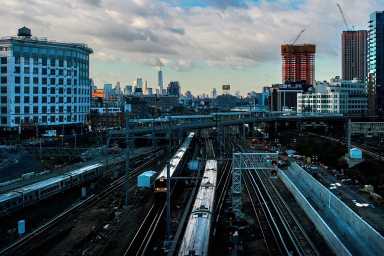
In Queens, where railroad tracks slice through neighborhoods like an ungainly scar, a vast expanse of steel and ballast known as Sunnyside Yards sprawls across 180 acres—roughly the size of Roosevelt Island. For decades, politicians and planners have floated visions of capping this working rail yard and raising an entirely new neighborhood overhead. Now, the long-mooted megaproject is abruptly edging toward reality, catalysed by a rare political alignment.
Last week’s White House summit between President Donald Trump and Mayor Zohran Mamdani put the $14bn Sunnyside Yards plan atop the national agenda. Their discussion centred on constructing 12,000 apartments, largely affordable, above one of America’s busiest rail interchanges in the heart of western Queens. The two leaders—otherwise ideological antipodes—presented a united front, framing the project not just as remedy for New York’s acute housing shortage, but as a model for US urban policy.
The stakes could hardly be higher. Metropolitan New York faces record rents and a shortfall of 500,000 housing units, according to the NYC Department of City Planning. What housing does get built skews ever further from the pockets of teachers, police officers and healthcare workers. For local businesses, the crunch is palpable: small restaurants, clinics and grocers complain that long commutes and sky-high housing costs are squeezing out the very workforce on which the city depends.
Sunnyside Yards sits atop a mass-transit nexus—served by Amtrak, the Long Island Rail Road, and half a dozen subway lines—making it, on paper, an urbanist’s fantasy for “transit-oriented development”. Proponents reckon that creating housing here will not only bring thousands of middle-income workers closer to their places of employment, but also inject foot traffic and consumer spending into Astoria, Sunnyside and Long Island City, whose vibrant retail and commercial corridors currently struggle to find staff.
Perhaps of equal salience, the city’s construction unions are salivating at the prospect of thousands of long-term trade jobs. The Building and Construction Trades Council estimates the project would support 25,000 person-years of union work, helping to buttress a middle class recently battered by Covid-era furloughs and inflation. In turn, such job creation could serve as a bulwark against the ongoing slow exodus of working families from the five boroughs.
Yet optimism should not be untrammelled. Decking over an active rail yard involves byzantine engineering, regulatory and procurement hurdles. New York’s infamous cost overruns and ponderous permitting process—remember the Second Avenue Subway?—bode for delays and ballooning expenses. Neighborhood opposition is all but guaranteed, with local activists already lambasting expected disruptions and clamouring for higher proportions of below-market housing.
The politics, at least for the moment, portend rare cooperation. That both the Mayor and an avowedly skeptical president would champion the project testifies to just how dire the housing crisis has become. If shovels enter the ground, it may signal that New York has finally embraced large-scale, technically complex infill housing—after half a century of piecemeal, municipal inaction.
Developers and city leaders are quick to call Sunnyside Yards a “once-in-a-generation opportunity.” In truth, its scale puts it closer to the legacy-defining “Robert Moses moments” of the mid-20th century, when the city last attempted to remake terrain wholesale. The project’s success or fizzle, therefore, could set precedent for how New York and its peers contemplate infrastructure megaprojects amid strained public finances.
On a national stage, the story resonates still wider. Cities from Chicago to San Francisco are wrestling with eerily similar dilemmas: Affluent neighbourhoods resist densification, while essential workers disperse ever further to cheaper peripheries, burdening public transport and splintering civic cohesion. The US has, for decades, lagged behind East Asian and European counterparts in redeveloping air rights above railyards. Projects in Toronto’s downtown and above Tokyo’s Shinjuku station make New York’s inertia appear particularly puny.
Bridging politics and bedrock: can the city deliver?
Economic gains, while enticing on paper, hinge on execution. Federal funding—likely part of broader infrastructure deals—would be needed to overcome upfront costs and de-risk notorious New York delays. Analysts at the Citizens Budget Commission warn that without ironclad fiscal oversight and transparency, the risk of spiraling expenditures (as seen at Hudson Yards) looms. For all the bipartisan goodwill, local politics remain volatile: a single lawsuit or vocal council member could mire construction in limbo for years.
Yet, the alternative—continued urban sclerosis, where only the highest earners and the luckiest rent-regulated tenants remain—bodes ill for the broader economy. New York’s status as a competitive, global city depends on affordability for workers as much as on glossy new towers or world-beating restaurants. Sunnyside Yards, by design or by accident, is evolving into a test of that central principle.
The cautious optimism with which we regard the project, then, is measured. It is heartening to see local and national leaders risking political capital on pro-housing policy amid entrenched opposition and inertia. But unless New York can prove that it can marshal the necessary resources, coordinate feuding agencies, and keep both labour and neighbourhood interests at the table, the whole exercise may concatenate into another cautionary tale of city-building bravado gone awry.
Still, with rents at historic highs and the city’s economic dynamism at stake, the cost of inertia outweighs even the most daunting logistical headaches. That President Trump and Mayor Mamdani see eye-to-eye on the bones of the deal is remarkable enough—now, it falls to planners, budget hawks and citizens to hold their coalition to account.
If New York can pull off Sunnyside Yards—delivering homes for the middle class, strengthening the urban middle, and proving that grand projects need not end in failure—it will set the tempo for major cities grappling with similar woes. If not, expect the city’s vaunted “can-do” spirit to be subject to even drier jokes than usual. ■
Based on reporting from amNewYork; additional analysis and context by Borough Brief.